In this unit, I am more concerned and exploring my understanding of painting images. The interactive relationship between art and social environment, as well as the explanation of the social and political conditions of modern life.
My works are related to my growth experience. I come from Beijing, which is an extremely modern and culturally rich Chinese city. I lived in the suburbs of northern Beijing in the 1990s when I was young. At that time, life was always surrounded by the surrounding primitive and natural giant parks. Due to family reasons, there are no children of the same age around me, and the relatively independent and lonely environment actually leaves me more time to observe the surrounding environment.
At that time, I felt like an explorer, and my daily life was basically breaking through the countless spider webs of the suburban areas on the forest trail, and then exploring a new mysterious corner in these huge parks. Of course, this mysterious corner was not really something magical, perhaps just a rundown fountain, a separate repair room, or a beehive? Or some unnamed small house, maybe where people live, maybe there are no people, but there are always some traces of humanity there. This may also be why although I come from Beijing, I have never depicted the bustling life in a huge city. I think the form of escape and loneliness in my works comes from this period.
In the second unit, I attempted to seek inspiration from the local area because I believe that the surrounding environment affects my own state. It is better to rely on memories and photos to draw past life, but the scenery next to me is the most direct source of inspiration.
Although this is my second visit to London, it is my first time living here for such a long time. In the first unit, I didn't dare to depict too much of the scenery here because I still felt like I couldn't grasp it, and my understanding may be fragmented. But now, thanks to the habit of strolling, I find many interesting scenery in parks, streets, and by the window.
Contemporary Landscape

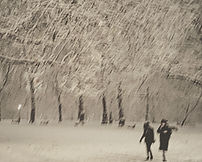


I was fortunate to have encountered a rare heavy snowfall in London here. From very late until the next day, I asked the restaurant owner when the last time there was such a heavy snowfall, and he said it had been three years. I have taken a lot of photos, and perhaps in the next exhibition, I will use some materials that are more suitable for painting. In short, this suddenly brought back many memories.
One of the paintings was the scenery outside my window. At first, I tried to draw directly from the real scene, but I found it too overwhelming for me. In a sense, I always get entangled in all the details. So I think back to what attracted me, as the material for my creation. However, in reality, I think what attracts me is the real image. It's just that the small park and trees in front of the house blend into one in the snow, and the building itself is only a blurry silhouette that seems to have disappeared from the photo. Really, it's like this place doesn't really exist. Later on, I drew another one to further blur the feeling, and I would have the same feeling. I just feel like these places are not real, not there!


Year1875
MediumOil on canvas
Dimensions71 cm × 91 cm (28 in × 36 in)
LocationNational Gallery, London
I think my creation is more like depicting an image that is firmly believed to be the truth, but this image (truth) lies between the exact scene and the scene in my mind. I often use deepened colors to create experiences, emotions, or feelings in a certain place, but this process is not scientifically organized. I think painting always needs to return to a certain truth that we have a common experience with. We have all seen unparalleled snow. We have all experienced the strange natural phenomena brought about by light. I think in a sense, I am using these natural phenomena, magnifying them with the materials and behaviors of painting. When the audience sees the heavy snow in front of the window, they will remember that experience. When I drew pictures about snow, I looked at many of Monet's works, and there were also many extreme and exaggerated color applications on the surface.
Different versions


During the creative period, I also saw a lot of Peter Doig's works,. Many of his creative materials may have been photos found in magazines like National Geographic or a segment from the magazine, or they may have been taken by himself. He also emphasized the abstraction of everyday things. I do feel that there is such a blind spot, especially in my memory, so I fantasize about doing more or experiencing more than I actually do. I turn actual experiences into imaginary things.
In March, Doig's works appeared at The Courtauld Gallery in London, with over a dozen works occupying only two small exhibition halls, but all of them are new works in recent years.
I like his works. His paintings are not copies of photography, but rather find a way out for the concrete painting of the photography era. Between reality and abstraction, he finds a dreamlike world that runs wild. For me, images need to carry the structure of shape and memory, and are improvised and responsible for emitting emotions.Also, when I drew this batch of skiing works, different versions of the images explained the proliferation of the story on the canvas.This influence may come from my reaction to previous works, where I want to change the way I always "see something through something". Whether it's through trees or snow, it's too ordinary.
Images themselves can become more open things. For example, in my recent works, some of them have already been completed to some extent, but later I overturned them and covered up the original ones. I am reflecting on why I need more control.This may also be why I drew different versions of my previous works. Because the carrying capacity and function of a painting are limited. I also feel that my subsequent versions are correcting previous errors. Or still exploring to preserve unknown factors.
Now, I'm thinking that sometimes I can leave things outside the canvas. I am trying - at least in some works - to use fewer materials to express the same emotions in past works. I am trying to simplify the use of content and materials.


Perhaps these feelings are symbolized through certain patterns, special scenes or locations, such as foxes wandering in the city on snowy nights, and bus stop scenery on suburban roads. Many works are related to the periphery or edges, such as the intersection between the city and nature. In such places, some objects of the city have almost become abstract shapes. There are many 'emptiness' in the picture. Many works depict images that appear to be in one place, but are missing another place.
The color saturated canvas lingers between clarity and blurriness. Photos and paintings provide me with a starting point, and I will ponder over and over again, replacing colors one version at a time, repeatedly. Sometimes it also allows the visuals themselves to develop intuitively. I believe that breaking through the existing visuals is also a new understanding and cognition of oneself and the present. As I said, go back to the same image and create multiple versions to better understand it.
Reflection from T. J. Clark’s The Painting of Modern Life
Since the publication of "The Absolute Bourgeois: Artists and Politics in France from 1848 to 1851" and "The Image of the People: Gustave Courbet and the 1848 Revolution" in 1973, the renowned contemporary art and social historian T J. The Portrait of Modern Life: Paris in the Art History of Manet and His Followers, "the third and most successful and representative work by T.J. Clark (1943-)
In "The Portrait of Modern Life", this method has been more fully utilized. Clark also explicitly elaborated on this strategy in the introduction. In my opinion, a painting cannot truly express' class', 'woman', or 'landscape' unless these categories begin to influence the visual structure of the work, forcing the established concepts of 'painting' to be put to the test. (This is the other side of the surface conservatism of traditional crafts such as painting: the purpose of changing or breaking rules - and their power and importance - will only become clear in practices where traditional rules and conventions still influence decision-making.) Because only when a painting reshapes or adjusts its procedures - related to visualization, similarity, conveying emotions to the viewer, size, strokes, beautiful sketches, and three-dimensional shapes When it comes to programs with clear structures and so on, it not only places social details but also puts the social structure under pressure
This not only echoes but also concretizes his 1973 discourse on how "the effective system of visual expression, recent theories of art, other ideologies, social classes, and more general historical structures and processes" are combined in a complex and uncertain manner in a single work of art And this combination occurs at a historical moment in modern art, "at least at a certain moment, it is possible to grasp the fixed expressions of general cultural phenomena, as well as the production methods of identity and differences - identity and differences related to self and others," inner "and" outer ", freedom and self-awareness, and so on. In other words, it is not just the 'landscape' and 'class', but the visualized landscape and class in a specific form, dividing the world into closed realms of objectivity, internality, and desire.
In Clark's theory, urban life is limited by capital. And capital "does not need bricks or altars on the ground to present itself, nor does it need to engrave a map in the minds of urban residents. People can even say that capital would rather let cities, such as Paris, lose images - without form, unimaginable, unreadable and misread, unable to generate conflicts of spatial claims - and then mass-produce its own images to replace what capital had destroyed, It is precisely the response of artists such as Manet to the collapse of social representation symbols and the crisis of representation systems.


In the book, Clark mainly analyzes four Manet's works in detail, using this method more or less, deep or shallow, in each chapter to identify changes to traditions or conventions in the works and reveal their indirect reactions to social reality. For example, 'The Choice of Olympia'. It has to be said that Clark's thirty page visual analysis of the painting 'Olympia' is dense, convoluted, and charming, but beneath the main thread of the book 'Portrait of Modern Life', I believe the most fundamental and decisive theme. Art should be held onto the arteries of the times - in such a society, "commodity" or "commodification" determines the structure of the chapter, which constitutes what Clark referred to as "overall social practice" - "landscape" in his introduction.
From the perspective of "landscape" as the coordinate point and perspective, my works "Pink Snow", "Bus Station", "Wish You Were Here", and "Wanna Step Outside" are basically arranged in chronological order, and their corresponding social phenomena are also the gradual invasion process of the landscape: (1) the loneliness and relative isolation of the city; (2) the uncertain holidays and people's lives in the suburbs of London, On the ambiguous interface between the bourgeoisie and history; (3) The face of urban private life, that is, the life of new young people in the city (4) Reverse the natural urban interest. These form a series of arranged images, and the relationship between these images inadvertently reveals the cultural reality of the city, which is that "cities, animals, suburbs, and stations" have gradually become the surface of the landscape. In my opinion, the arrangement and corresponding urban life of these four paintings demonstrate the process of "landscape" invading from public places to private places and into the world of daily life: urban streets, suburbs, and parks. Just like in "The Portrait of Modern Life", Clark takes the Ottoman transformation of Paris and the rapid progress of commercial capitalism as the background of the "landscape", describing the rise of the petty bourgeoisie in society in the second half of the 19th century and its special pursuit of lifestyle and aesthetic interests, thus revealing the complexity and ambiguity of Manet's paintings.
In my opinion, my painting, like Manet's painting, is precisely the representation and consequence of landscape social ideology: the flatness of visual space, the inadequate or ambiguous representation of social class.

In order to further study the 'meaning' in the work, I listened to Professor Geraint Evans' suggestion and in this unit, I conducted a research on T J. Clark's book research. Specifically, I focused on his book 'The Painting of Modern Life',
As early as in "The Image of the People", Clark developed a research method that links artistic works with other social processes, examines them in a historical context, and identifies the imbalances in the painting. He then analyzes how this new form, which is different from traditional artistic practices, reflects changes in social ideology and class conditions. These ideas are very important for my painting practice, as they help me reflect on my understanding of images in painting. Interestingly, I have always believed that the elements I chose were purely for aesthetics, but this is not the case.
From the perspective of "landscape" as the coordinate point and perspective, 《pink snow》, 《Bus Station》, 《Wish You Were Here》, and 《Wanna Step Outside》 are basically arranged in chronological order, and their corresponding social phenomena are also the gradual invasion process of the landscape: (1) loneliness and relative isolation in the city; (2) London's suburbs, uncertain holidays and people's lives, On the ambiguous interface between the bourgeoisie and history; (3) The face of urban private life, that is, the life of new young people in the city (4) Reverse the natural urban interest. These form a series of arranged images, and the relationship between these images inadvertently reveals the cultural reality of the city, which is that "cities, animals, suburbs, and stations" have gradually become the surface of the landscape. In my opinion, the arrangement and corresponding urban life of these four paintings demonstrate the process of "landscape" invading from public places to private places and into the world of daily life: urban streets-suburbs-parks.
On the surface of traditional craftsmanship such as painting, reflection can only make the work clearer by changing or breaking the purpose of traditional rules and practices that still influence decision-making - and their power and importance.

This makes me think about how to use visuals and similarities in my own practice, because only when a painting reshapes or adjusts its program - conveying emotions, dimensions, strokes, beautiful sketches and three-dimensional shapes, clear structures, etc. to the viewer, can it not only put social details under pressure, but also put social structure under pressure.
And this modernity factor is precisely the new story of landscape invading all aspects of society and the world of daily life.