
T A L K


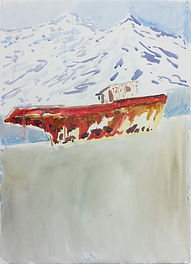


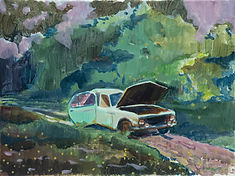


at the beginning, I just tried to live and integrate into local life. I wish to make some present works, or real local works, or finding the ideas and thoughts from here.
As usual, the most I do is go to the park. I have always admired the magic and greatness of nature. I took a lot of photos and sketches. I think this is a good help for me to help me control the picture.
The two pictures in front are like my first image when I came to London. autumn seathen
I actually want to draw some current themes, girls in the park in autumn, and dogs. Of course, I have also been doing landscape research.
The characters in my original pictures are always separated from the scenery. The girl's picture was too realistic in the background at first. I changed it many times and replaced the ripples on the water with more abstract lines and light spots. In fact, the girl's head is still big, but I think the background has changed from the original one, so I still left this one and did not continue to change it. It should be achieved for the purpose of the experiment.
I was luckey to have encountered a rare heavy snowfall in London here. From very late until the next day, I asked the restaurant owner when the last time there was such a heavy snowfall, and he said it had been three years.
this paintings was the scenery outside my window. At first, I tried to draw directly from the real scene, but I found it too overwhelming for me. In a sense, I always get entangled in all the details. So I think back to what attracted me, as the material for my creation.
so I think what attracts me is the real image. It's just that the small park and trees in front of the house blend into one in the snow, and the building itself is only a blurry silhouette that seems to have disappeared from the photo. Really, it's like this place doesn't really exist. Later on, I drew another one to further blur the feeling, and I would have the same feeling. I just feel like these places are not real, not there!
I often use snow to describe scenes, because snow always carries many of my memories and experiences. Snow is a beautiful visual effect that can always affect people's emotions and thoughts in some way. I think of it as both a representational subject and a mode of rendering, just like the way its paint is arranged in a painting, forming a hybrid that sometimes appears and sometimes disappears. I responded to it a lot in this year’s paintings: boats, water, mountains, weather, light. Putting these interesting elements together with the dreamy and sweet effects of snowflakes can give the picture a decorative and dramatic effect. .
The two paintings "boat" and "snow", like many of my other paintings, I made up a lot of the appearance form of snow. Like "boat", I divided the snow into three forms: linear snow mountains, snow covering the ground like a gauze, and snow rocks on the edge. In this work "snow", I turned snowflakes and light into dots of different sizes. Some of them are actual snowflakes, and some of the light is like the material of falling snowflakes. These paint spots have even become the background color of paintings and drawing boards. I turned their style into an ambient effect. It's like a screen, like "christmas night". The screen can also be virtual, like a movie or projected into an indeterminate space, extending the literal meaning of snow. Sometimes appearing and sometimes disappearing, the image fades in and out of the snow.
The same idea, when I look \snow, snowfield, snowy mountains, they break the boundaries and become a form, I like it, like a screen, allowing you to see through it Other scenes. It is no longer a perspective, but an idea, a concept of snow.
i think Images themselves can become more open things. For example, in my recent works, some of them have already been completed to some extent, but later I overturned them and covered up the original ones. I am reflecting on why I need more control.This may also be why I drew different versions of my previous works. Because the carrying capacity and function of a painting are limited. I also feel that my subsequent versions are correcting previous errors. Or still exploring to preserve unknown factors.
Perhaps these feelings are symbolized through certain patterns, special scenes or locations, such as foxes wandering in the city on snowy nights, and bus stop scenery on suburban roads. Many works are related to the edgesland, such as the intersection between the city and nature. In such places, some objects of the city have almost become abstract shapes. There are many 'emptiness' in the picture. Many works depict images that appear to be in one place, but are missing another place.
some time I way replacing colors one version at a time, repeatedly. Sometimes it also allows the visuals themselves to develop . I believe that breaking through the existing visuals is also a new understanding oneself . look like go back to the same image and create multiple versions to better understand it.
I am interested in mixed spaces where subur area and the natural environment meet. "Fence" is the first stop of unit 3 painting. The nameless fence... carries a path and incomplete stone walls waiting for maintenance, which is something that few people Noticed the view.Behind the yellow warning town and the orange fence are hills and grass. I textured the sky and road. It could have been done with more content, but I wanted to simplify it by blurring the image space. oolpp.p..l., like A view into consciousness. I think the fence I saw was much closer and more interesting than I thought.
In the early 1990s, I grew up in the suburbs of Beijing. My childhood was spent in the northern suburbs of Beijing. There is a bus stop in the field, a small water canal, and walking through a tall banyan tree to the community where my grandfather lives. There is a small factory in the community, probably for machinery maintenance, and then there are some very wild parks and numerous bush areas. It is easy to walk for a short time and find yourself lost in a back alley or wasteland; along the Explore the perimeter of the wooded neighborhood; an old path through rough scrub, straight, narrow, overgrown in places, through fields and woodland. It’s easy to find yourself on the edge of farmland. The railroad tracks have disappeared, but the roads are littered with industrial remnants: crumbling, overgrown brick buildings and rusted scraps of metal machinery. For a child, it was paradise on the edge.
anthern reason is
Anyone who spent a childhood wandering around the edges of Beijing, when the city and suburbs chanleged their borders, will remember the scenery with nostalgia. Now the bushes, wastelands, and old neighborhoods where I lived have become urban scenery. I think these works are a continuation of my complex reflections on landscape writing and marginal areas in unit 2 "bus station".
For me the edgelands is a complex landscape. A contested region that is constantly reinventing itself as economic and social trends come in and out. If the beauty of parts of Britain's remote countryside can confer a sense of timelessness, the edgelands have an entirely different feel. It’s more story-telling, more casual, and more present! Think back to Beijing, every summer, or for a few months. Revisiting the edgelands areas where I lived, when I go there again, it is likely that they will be rebuilt, the demolished factories will be turned into new business, and the uncared for wild lands will be cleared and beautified with new neat bricks. Parks, abandoned cars, and warehouses have all become completely orderly things. The urbanization process is so fast. While you lament the progress of the city, it more easier make me miss those spaces that can be explored and written.It's Not only is it more natural and colorful, it also provides unique records of culture. I think this is a more harmonious balance between humans and nature.
In June I started working on "a sky full of stars" thanks to the larger space.
I feel like this is the relatively successful painting I've done here. I think this is my other narrative, and I very much hope that this narrative can be very open to interpretation, like the inverted snow-capped mountains, the aurora and stars echoing the deep water, and the car's rearview mirror - that gradually disappears Lost scenery. In this painting I tried to introduce hints, something that can evoke a wide range of experiences.
In terms of imagery, the northern lights and snow capped mountains seem to evoke an incredible feeling. But I hope that these unique elements in the picture can resonate like the scenery of the street ahead - not that familiar feelings become unfamiliar, but rather the opposite: unfamiliar things become familiar. I tried to break down some of the content itself, to some extent like disrupting my sense of reality in memory. It's like integrating memories, real-life images, and perceptual experiences into this painting.
It also fits the Contemporary Art and Memory: Images of Recollection and Remmbrance written by Joan Gibbons. This not only focuses on my personal memory, but also serves as the art of my autobiography, which can serve as an archive, revisionist memory and postmemory, as well as the absence of memory in oblivion. finally to public memory.
This is the second large-scale work I made here in Camberwell. This scene was not something I saw personally. Just like the video above, it actually came from Russian news in the 1980s. A helicopter fell in Russia. Central forest lake area. In fact, this is a very sad news, but when I saw that after years of natural changes, it has been integrated into the scenery here, and even this accident has become another event. The lost, dilapidated man-made landscape here should have corresponded to the theme of drowning, rescue, and loss, but after it was integrated into nature, it evolved into a tragic beauty.
I think that, like the scene's mere abandoned human landscape, anything incidental or inconsequential to the recognized themes of life may have no direct significance. But we can't come up with a convincing explanation for why they happen or what their current implications are. Facing this scene, even though someone was describing its process, it had already entered my imagination when it appeared to me in the form of an image or photo. And in painting this painting, it becomes an active memory, like the film image itself recording its story, which has added ambiguity and new colors.
I tried to make a painting about sound, like a sound moving through an emptiness that happens to be water. I guess that was my initial connection to this painting.
I love finding things that float, and that nature has a story and a plot to it, and it's even a little weird. The helicopter that crashed into the lake certainly reminded me of the ongoing wars in the world. Although it was an accidental event and not the first thing I imagined, it evoked my thoughts about the end of the war. The imagination of the subsequent scene.